


With more internet-connected devices in use today than ever before, it only follows that endpoint threats are increasing. A Ponemon Institute report found that not only is the rate of endpoint attacks increasing, the costs associated with them are increasing as well. Cybercriminals evolve quickly and often innovate faster than security providers. Meanwhile, more people than ever are working from anywhere—using any device they want to connect to any internet source available.
This all adds complicated layers to IT and security’s job of keeping endpoints secure. The answer lies in modern endpoint management—the combination of technology and the right partner’s expertise. But that can feel easier said than done for any IT leader today.
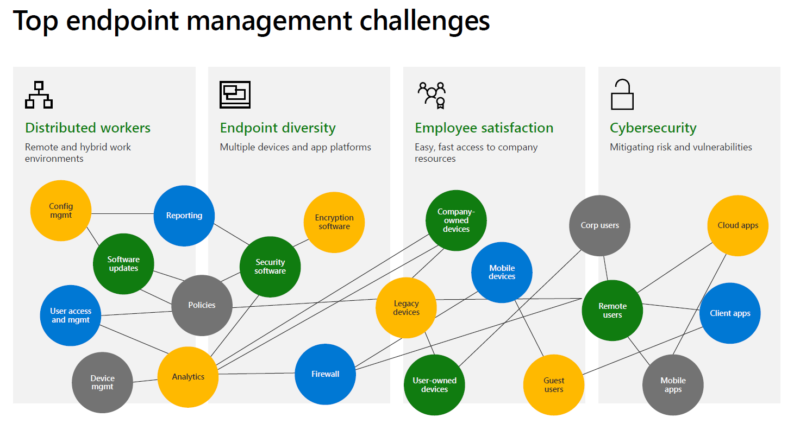
There are four major endpoint management challenges for organizations.
Read on to dive into each and how to solve them.
Challenge 1: Distributed workers
The evolution of the distributed workforce is perhaps the most bald-faced reason modern organizations have difficulty properly managing their endpoints. Remote and hybrid remote work environments have complicated nearly everything about business security—and they aren’t going anywhere anytime soon. Employees in your distributed workforce are not just using their own devices to access company material, they are doing so through unsecured internet connections you can’t govern.
Challenge 2: Endpoint diversity
Multiple devices and app platforms naturally complicate the endpoint security landscape, and IT leaders know this. 48 percent of IT leaders say ensuring data security is their top challenge in supporting end-user productivity. The more diverse your company’s endpoints—whether that be how they vary in location, operating system, device type, or other—the trickier it is to manage and secure your device fleet.
Challenge 3: Employee satisfaction
44 percent of remote workers say they have access but not to everything they need. Providing easy, fast, secure access to company resources is a chief objective of IT teams in today’s dispersed workforce environment—but that can also be a tall order. IT knows just as well as anyone that happier employees are more productive employees, creating even higher stakes for adequate endpoint management.
Challenge 4: Cybersecurity
It’s difficult to overstate the importance of mitigating risk and vulnerabilities in today’s era where increasingly vicious, sophisticated cyber threats proliferate around the globe. 65 percent of enterprises need to ensure security and compliance across multiple device types—or risk becoming just another statistic.
Solve These Challenges with a Modern Endpoint Management Solution
Modern endpoint management includes seven components:
- Putting cloud intelligence at the core
- Improving the end-user experience
- Simplifying IT administration and operations
- Quickly solving issues with automated and data-driven support services
- Adding protection across the Zero Trust security model
- Consistently managing existing and emerging devices
- Empowering a strong partner ecosystem
Tying these components together allows organizations to not only secure each endpoint properly, but to ensure employee satisfaction and strengthen their security postures. To achieve these goals, businesses leverage Microsoft Endpoint Manager—a solution that combines Microsoft Intune and Configuration Manager to enable the management of endpoints with the protection of a Zero Trust strategy. The solution allows businesses to leverage:
- Unified management: All your apps, device controls, and insights are in a centralized, cloud-based platform for simple access and visibility.
- Built-in protection: Your IT team can apply the controls needed for a Zero Trust security model to protect all digital assets without inhibiting user productivity.
- Comprehensive scalability: With intuitive management controls, workflows, and analytics, you can ensure compliant, successful device and app deployments.
Microsoft Endpoint Manager also helps organizations extend the benefits of cloud management, provide business continuity to remote workers, and manage both physical and virtual assets. You’ll gain the ability to proactively remediate vulnerabilities while better managing your overall digital health.
Point Alliance is a Microsoft partner committed to helping organizations leverage the power of Microsoft Endpoint Manager. Discover how easy it is to protect every single device for every single employee on your network by contacting us today.