

What makes your house a home? Many people might respond that it’s the people (and/or pets) in it. The experiences of connecting with others transform a space. The same is true for offices, and the pandemic shone an unavoidable light on that truth. People who have returned to some form of office life know they aren’t going because of the building or commute. They’re going for the people.
But in a modern office setting—where some employees are working remotely and some are physically present—how can business leaders maintain this important experience? The right platform is the answer, and Microsoft has heard the call. In late 2022, Microsoft unveiled Microsoft Places—a Connected Workplace platform to help you reimagine hybrid and in-person work. Learn more about it here.
What’s the Connected Workplace?
The Connected Workplace is a new category of technology, according to Microsoft, that helps to create modern workplaces with technology to support every employee. It can adapt to employees’ evolving needs by using data collected from these workplaces to help organizations change as employees’ desires change.
Part of what’s driving the Connected Workplace is research from Microsoft conducted in September 2022 that found that 73% of employees and 78% of business decision-makers say they need a better reason to go in to the office than just company expectations. The motivation is no longer, “Because I told you so,” and executives need to accept this fact. 84% of employees would be motivated by the promise of socializing with co-workers, while 85% would be motivated by rebuilding team bonds, the research found. With social connection as the supreme driver for the commute, Connected Workplaces step in to facilitate a new approach to the future of work.
How Does Microsoft Places Work?
There are three main functionalities of the solution:
Leveraging insights to optimize space
Business leaders need understand how their spaces are being used to truly optimize them for the modern employee. Microsoft Places helps you plan for expected occupancy so you can reduce available floors when needed, save on energy expenditures, and dynamically adjust spaces like huddle rooms depending on occupancy.
Plan smarter, not harder
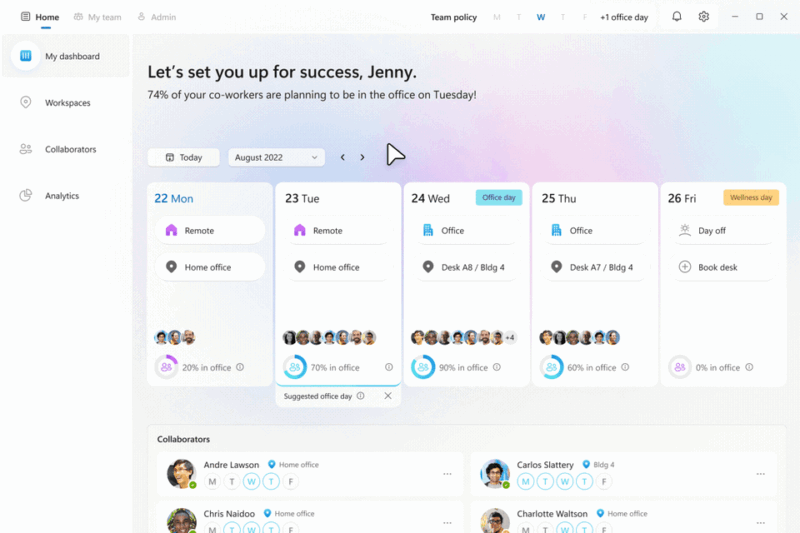
Microsoft Places integrates with Outlook and Teams to facilitate hybrid scheduling. Using common data signals from these apps, the solution helps you view when employees plan to be in the office a full week ahead. This advanced planning helps with the aforementioned occupancy guidance and space optimization.
You can also make schedule adjustments to better take advantage of packed in-person days. With intelligent booking, the solution enables you to match meeting purpose with the right available spaces. It even makes recommendations for shorter commute times based on traffic and scheduled meetings. Employees will maximize their in-office time without feeling like they have wasted a commute.
Features for a more responsive office
- Wayfinding helps employees find the right meeting place with maps on mobile devices.
- Hot desk booking shows you where colleagues have gathered so you can choose the desk to best support your work and collaboration with them.
- Microsoft Teams Rooms gives all employees—regardless of location—an inclusive meeting experience.
- Spontaneous meet-ups allow employees to create less-formal ways to collaborate.
Microsoft Teams Rooms also offers several features that are essential for the success of your Microsoft Places solution:
- Interactivity with inclusive video layouts, intelligent speakers, collaborative whiteboarding, and more.
- Ease of use through one-touch join, Microsoft calendar integrations, Cortana voice assistance, and more.
- Flexibility through multiple types of devices, support for Windows and Android, and interoperability of other kinds.
- Security with AI-driven managed services, remote provisioning, inventory management, and securely delegated administration.
Make Your Commitment to the Employee Experience Clear with an Optimized Office
Most businesses are at risk for employees defecting for a number of reasons. If employees can’t learn and feel like they can make progress, they’re not likely to stay. (The same research showed 76% of employees say they’d stay at their company longer if they could benefit more from learning and development support.) And lack of flexibility is another huge driver of defection—not just in office space.
77% of Gen Z and Millennials in Microsoft’s research said they are more likely to stay at their current company longer if the company gave them the flexibility to pursue side projects or businesses for additional income. While this fact might not seem related to optimizing your office space, offering a more flexible work experience in the office directly translates to supporting the employee experience outside the office. It is an opportunity to demonstrate your organization is ready to provide the flexibility these younger generations desire, and it represents your commitment to supporting their goals. More satisfied employees equal less churn for you—and greater resiliency and stability.
Ready Your Business for the Future of Work with Microsoft Places
Point Alliance has decades of experience helping organizations of all sizes leverage Microsoft’s technologies to support scalability and growth. 2023 will be no different. With the launching of Microsoft Places, we are your go-to advisor for eliminating “commute-regret” and cementing a happier workforce. Get in touch with us today to discuss your organization’s needs and start leveraging data and technology to attract competitive talent—and keep it.